What Is an SRO, and What Are SRO Codes on the Tax Return?
Two quite different things get called an SRO, and if you file your own return you will meet both. One is a line on a supplier’s invoice — “exempt under SRO 1125(I)/2011”. The other is the wall of four-digit numbers running down the side of the FBR’s return form, which most people scroll past without ever being told what they are.
They are connected, and the connection is worth understanding before the 30 September deadline.
What an SRO actually is
SRO stands for Statutory Regulatory Order. It is a notification issued by the government — for tax matters, by the Federal Board of Revenue — using powers that an Act of Parliament has already handed to it.
That is the whole idea. Parliament passes the Income Tax Ordinance 2001 or the Sales Tax Act 1990, and inside those laws are clauses saying, in effect, “the Board may, by notification in the official Gazette, exempt…” or “…may prescribe the form”. An SRO is that notification. It is delegated legislation: not an Act, but law all the same, and binding until something withdraws it.
In practice SROs are used to grant or withdraw an exemption, set a reduced rate, prescribe rules and procedures, and — the one that matters here — notify the return forms you have to file on.
How to read an SRO number
The citation looks cryptic and is actually simple. Take SRO 835(I)/2026:
| Part | What it is |
|---|---|
| SRO | Statutory Regulatory Order. |
| 835 | The serial number, running in sequence through the year. |
| (I) | The part of the Gazette it appeared in. Part I carries statutory notifications of general application — the ones affecting taxpayers at large. |
| 2026 | The calendar year of issue, not the tax year. |
“SRO 835” on its own means nothing. There is an SRO 835 in most years and they have nothing to do with one another. Always quote the year, and the part in brackets with it.
SRO 835(I)/2026, the one behind this year’s return
On 7 May 2026 the FBR issued SRO 835(I)/2026, publishing the draft electronic income tax return forms for tax year 2026 — covering individuals, small and medium enterprises, associations of persons and companies — and giving stakeholders seven days to comment before the forms were finalised.
That is the ordinary annual cycle: the return form is not simply written by the FBR’s IT department, it is notified, because the law requires the prescribed form to be prescribed. This year’s draft drew unusual comment for how much more it asks of a salaried filer — employer registration numbers, employer names and a breakdown of deductions among them.
Which brings us to the numbers people are actually searching for.
So what are “SRO codes”?
When people say SRO codes in the context of filing, they mean the numbered fields on the return form — the code sitting beside every line you can put a figure against. They are called SRO codes because the form that defines them arrives by SRO.
Open the return in IRIS and every line has one:
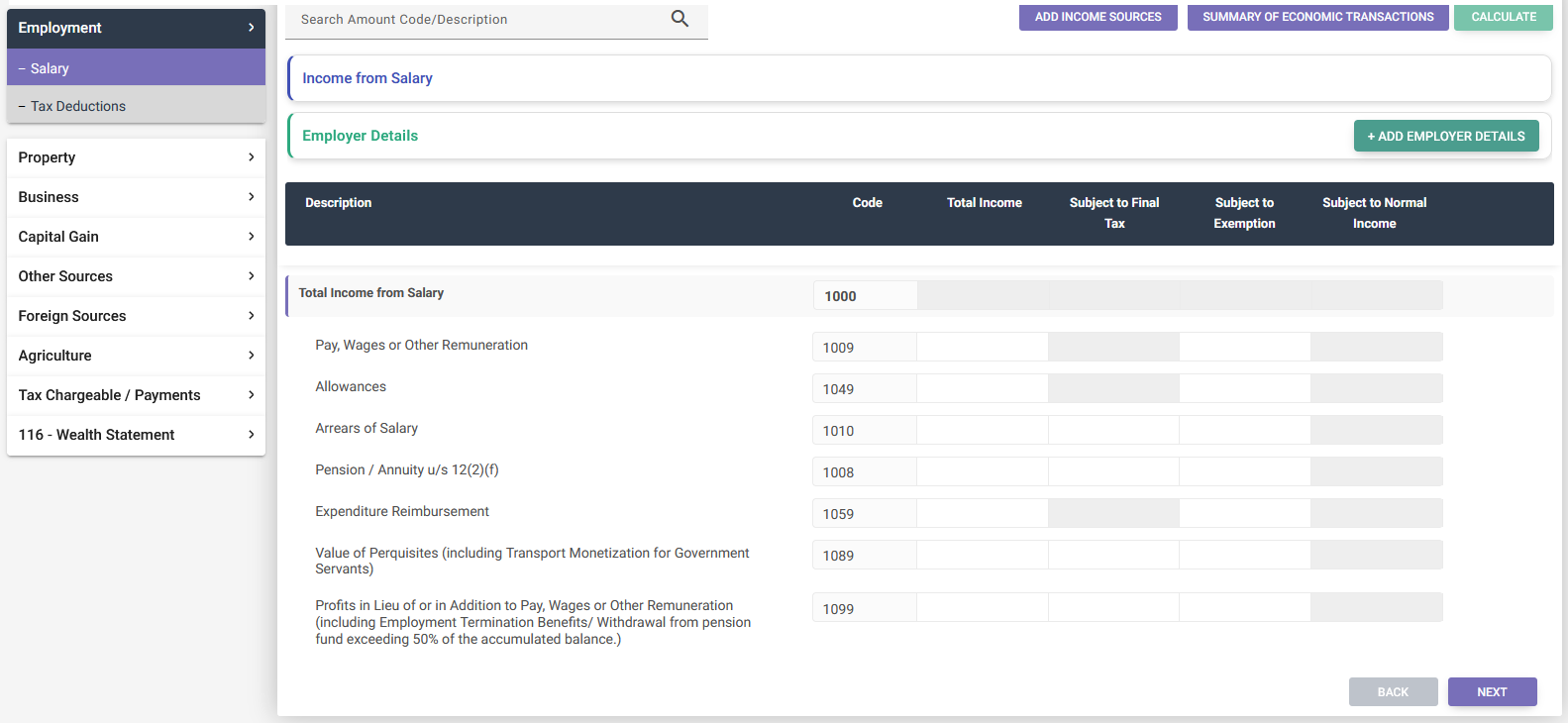
So on the salary side, 1009 is pay, wages or other remuneration; 1049 is allowances; 1010 is arrears of salary; 1008 is pension or annuity under section 12(2)(f). 1000 at the top is total income from salary — and you cannot type into it, because IRIS works it out from the lines beneath.
The code is the stable identifier. Wording gets reworded between years; the number is how the FBR, your accountant and any software all refer to the same box.
The codes are grouped by where the money came from
The return is organised into heads of income — Employment, Property, Business, Capital Gain, Other Sources, Foreign Sources, Agriculture — plus tax chargeable and the wealth statement. The leading digits follow that structure, which is why business expenses sit in the 3000s:
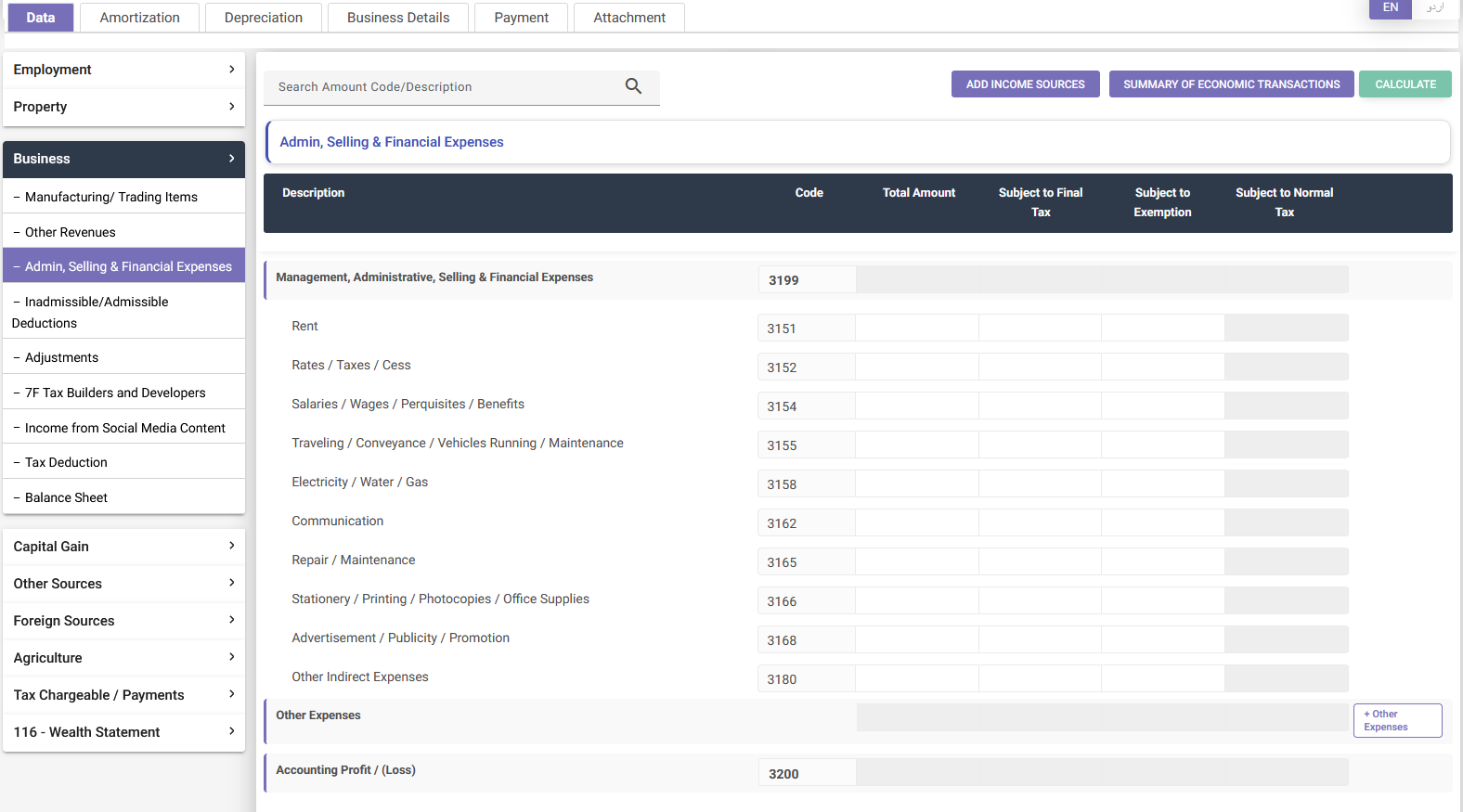
⚠️ The same words can appear under two different codes. “Repair / Maintenance” exists both in cost of sales and again in administrative expenses, under different numbers. Searching the form by wording will find you the wrong one; the section it sits in is what decides which is right.
Some codes repeat, and some you cannot type into
Two behaviours confuse people more than anything else on the form.
Computed codes. Totals and heads — total income from salary, total expenses, tax chargeable — are calculated by IRIS and are read-only. If your own figure disagrees with the form’s, something below it is wrong. Do not go looking for a way to type over the total.
Repeatable codes. Others carry a “+” control, and you add one entry per real-world thing — one per property, one per vehicle, one per bank account. The code stays the same on every row:
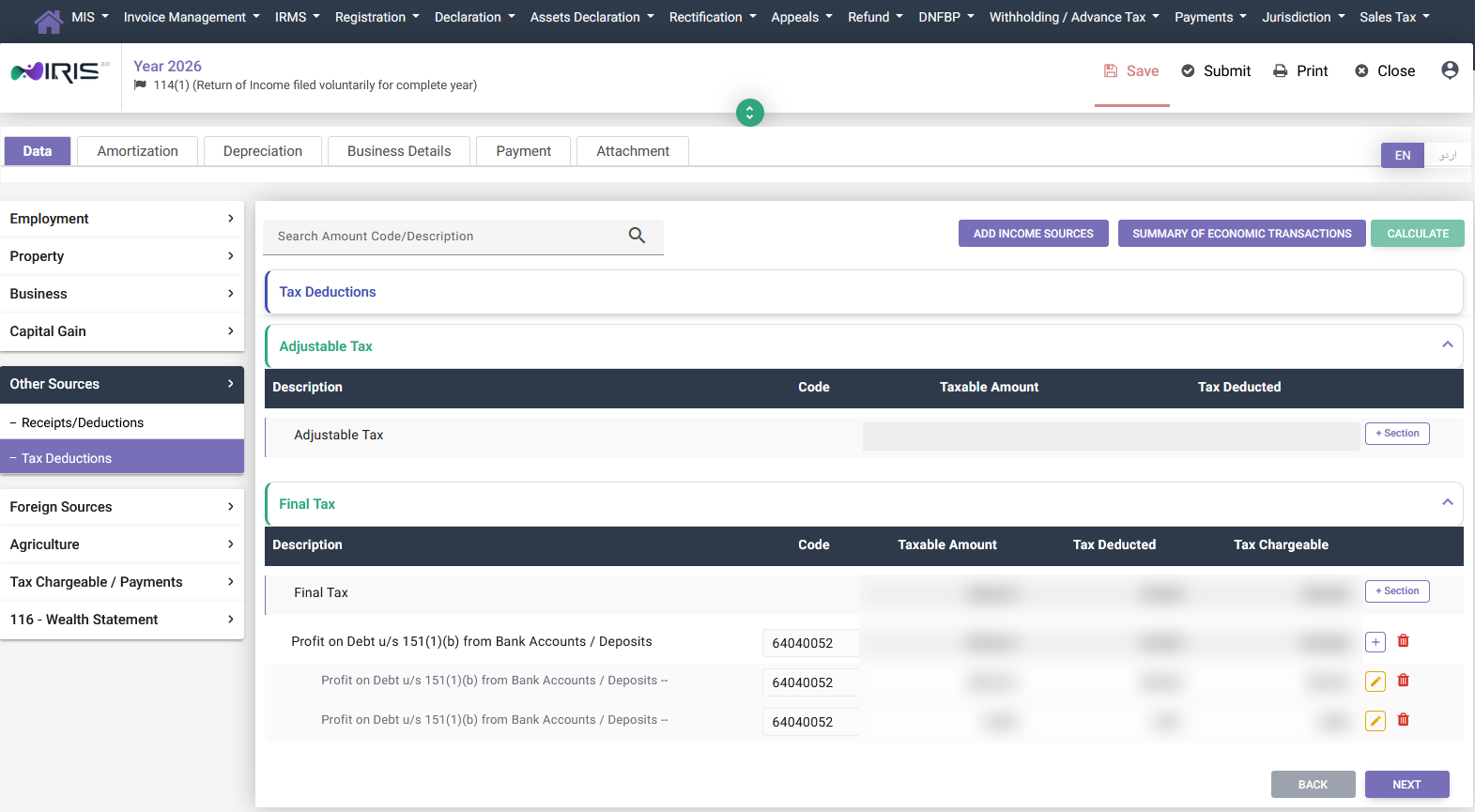
The 64-prefixed family is withholding: tax already deducted from you during the year, entered against the section it was deducted under. This is also where the adjustable and final split lives, and it decides whether the money comes back to you. Adjustable deductions count towards your bill; final ones do not, and cannot be reclaimed.
A handful of codes simply break the pattern — there is a minimum-tax code under the capital gain head that does not follow the family it sits in. It is correct as it stands, and tidying it up would be wrong.
Draft is not final, and the portal is the authority
This is the practical warning, and it applies to every SRO, not just this one.
SRO 835(I)/2026 issued the return forms in draft, for comment. A draft is a proposal. What you actually file on is the form as it stands in IRIS, and between a draft SRO and the live portal there is a consultation period in which things change.
The same is true across the board. SROs are amended, superseded and rescinded by other SROs, and the original text stays online, perfectly readable, long after it stopped being the law. SRO 1125(I)/2011 is the standard cautionary tale — for years it governed reduced rates for five export sectors, it was rescinded in 2019, and it was still being quoted on invoices long afterwards by people working from old templates.
So before you rely on one:
- Check whether a later SRO amends or rescinds it — the amending order cites the original by number and year.
- Check whether that year’s Finance Act has overtaken it. An Act beats a notification issued under it.
- For codes, check the live form rather than the SRO’s PDF. Where the two differ, the form you are filing into is the one that counts.
Where to find the real thing
The FBR publishes the full set at fbr.gov.pk/sros, split into Income Tax, Sales Tax, Federal Excise and Customs, with amending and archived orders kept separately. The return itself lives in IRIS.
Do not rely on a PDF someone emailed you or a summary on a consultancy blog. Both are fine for understanding what an SRO did. Neither tells you whether it still does.
Common questions
What does SRO stand for?
Statutory Regulatory Order — a notification issued under powers delegated by an Act, published in the Gazette of Pakistan, and binding as law until amended or rescinded.
What is SRO 835(I)/2026?
The FBR notification of 7 May 2026 that issued the draft electronic income tax return forms for tax year 2026, for individuals, SMEs, associations of persons and companies, with a seven-day window for comments.
What are SRO codes on the tax return?
The numbered fields on the return form — 1009 for pay and wages, 3151 for rent, and so on. They are called SRO codes because the form defining them is notified by SRO. The code, not the wording, is what identifies the field.
Why can I not enter a figure against some codes?
They are computed. IRIS derives totals and heads from the lines beneath them, so they are read-only by design. A total that looks wrong means a line below it is wrong.
Why does the same code appear several times?
Because it is repeatable — one entry per property, per vehicle, per bank account. The code identifies the kind of item, not the individual one.
What does the (I) mean?
The part of the Gazette in which it was published. Part I carries statutory notifications of general application.
Related reading
- How to become a filer — registering on IRIS and filing the return these codes belong to.
- Income tax calculator — what the salary side should come to.
- The wealth statement — the other form, with its own codes.
- Definitions — the rest of the vocabulary.
Last updated: 27 August 2026.
Sources: SRO 835(I)/2026 dated 7 May 2026 (draft income tax return forms, tax year 2026); Federal Board of Revenue, SROs / Notifications at fbr.gov.pk/sros; the IRIS return of income under section 114(1) for tax year 2026, read from the live portal. Income Tax Ordinance 2001; Sales Tax Act 1990.
Screenshots are of the IRIS portal for tax year 2026. Amounts have been blurred; no taxpayer name, CNIC or registration number appears in any of them.
This article gives general information about tax in Pakistan. It is not advice on your own situation. Rules and rates change, sometimes in the middle of a year. Before you act on anything here, check the current position with the FBR or a registered tax practitioner.